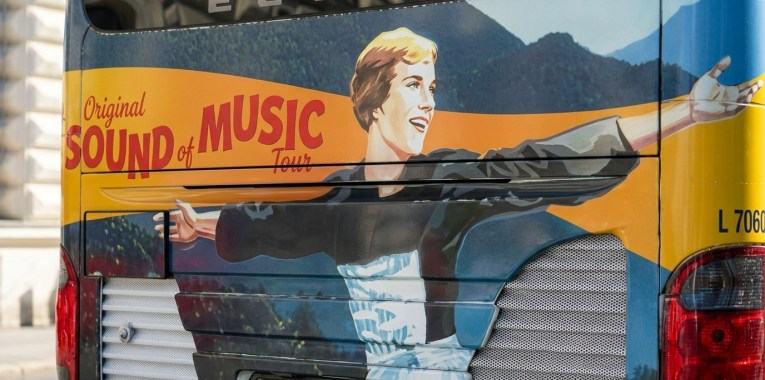
I have declared many times that I am the World’s Biggest Sound of Music Fan. I have seen the film well over ten times since I first watched it on the big screen with my grandmother.
Later in life, I became friends with a woman called Marty Hammerstein. I had absolutely no idea that her grandfather, Oscar Hammerstein, had written those famous lyrics. Marty casually mentioned who her granddad was one day. I was stunned. Of course, I had to tell her that he was probably turning in his grave listening to my renditions.
I know the words to all the songs. As a child, I reenacted every scene with my toys (it’s an only-child thing). I waltzed around an imaginary pavilion. And I dreamed of going to Salzburg to see where it all took place, to discover whether the reality could make it any more vivid in my imagination than it already was.
In July 2026, I was invited to Vienna by Austria Tourism. This gave me a couple of days beforehand to spend in Salzburg and, at long last, fulfil my childhood dream.
Salzburg and the Sound of Music
I later learned that The Sound of Music was met with considerable resistance in Austria when it was released in 1965. Many objected to its historical inaccuracies and were uncomfortable revisiting memories of the Anschluss, which they would rather forget. I was told that the film wasn’t shown in Austria until 1986, but please don’t cite me on that.
Today, The Sound of Music is credited with bringing between 300,000 and 350,000 visitors to Salzburg each year, generating millions of euros for the local economy. The tours flourish, and in September 2026, a Sound of Music Museum opened on the grounds of Hellbrunn Palace.
A visit to the Salzburg Marionette Theatre is also well worth considering. Its summer program includes a full-length version of The Sound of Music. There is irony here: the theatre’s director was approached to make the puppets for the Lonely Goatherd scene but declined, reportedly because many locals had little appetite for the film’s depiction of Salzburg during the Nazi era. The scene was ultimately filmed in a Los Angeles studio with American-made puppets.
My Home in Salzburg: Hotel Sacher
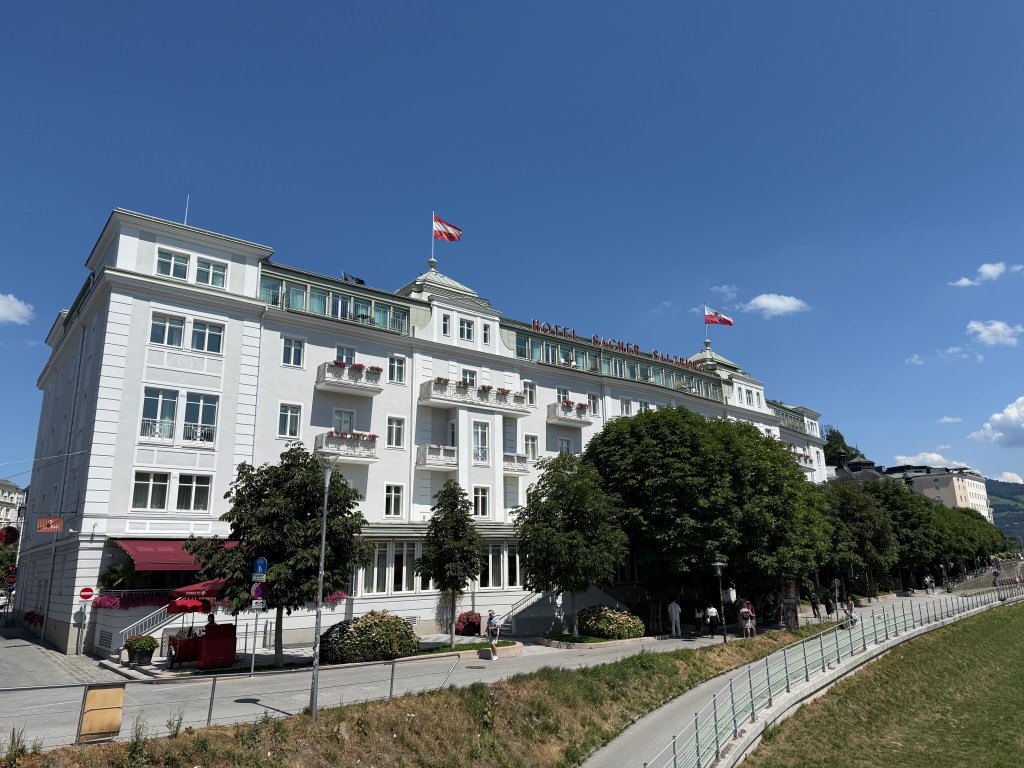
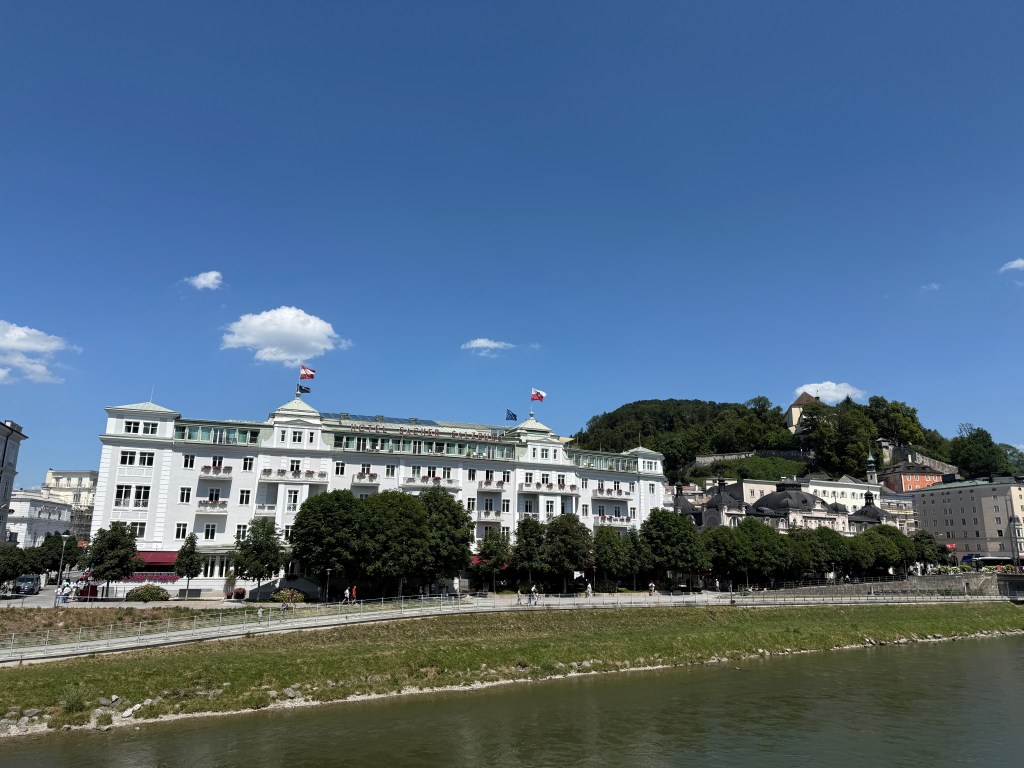
I arrived in Salzburg full of wonder and headed straight for the world-renowned Hotel Sacher. As I’d told my Virtuoso contact there, “I don’t want to stay anywhere else.”
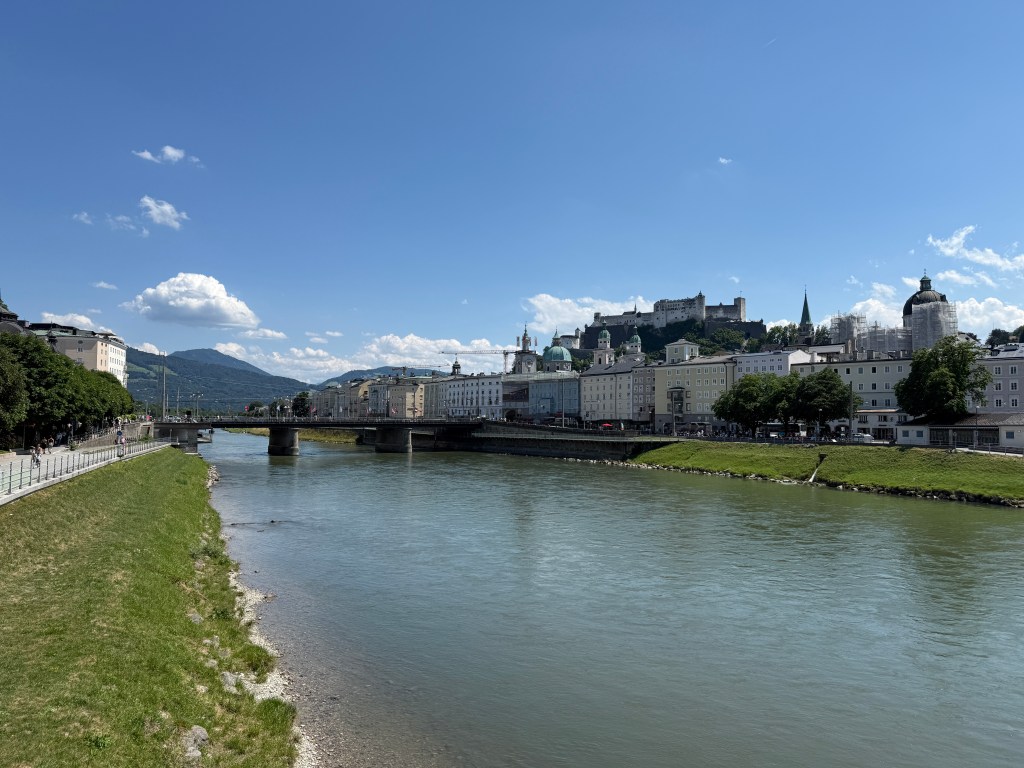
I love a classic hotel, the more storied the better. The Hotel Sacher is perfectly positioned in Neustadt (the New Town), close to Mozart’s former residence on Makartplatz and the Mirabell Gardens. Just outside the hotel is the Marko-Feingold-Steg, a pedestrian bridge leading across the Salzach River to Altstadt, Salzburg’s UNESCO World Heritage-listed historic centre.
And here’s the best part: Julie Andrews stayed at the Hotel Sacher during filming. For the record, I did not ask for her suite.
I am a self-confessed chocoholic, and I have to say that even the Sacher overwhelmed me with more chocolate than I could manage. The icing on the cake, quite literally, was a personalised Sachertorte, with my box inscribed and a lovely welcome note tucked inside.
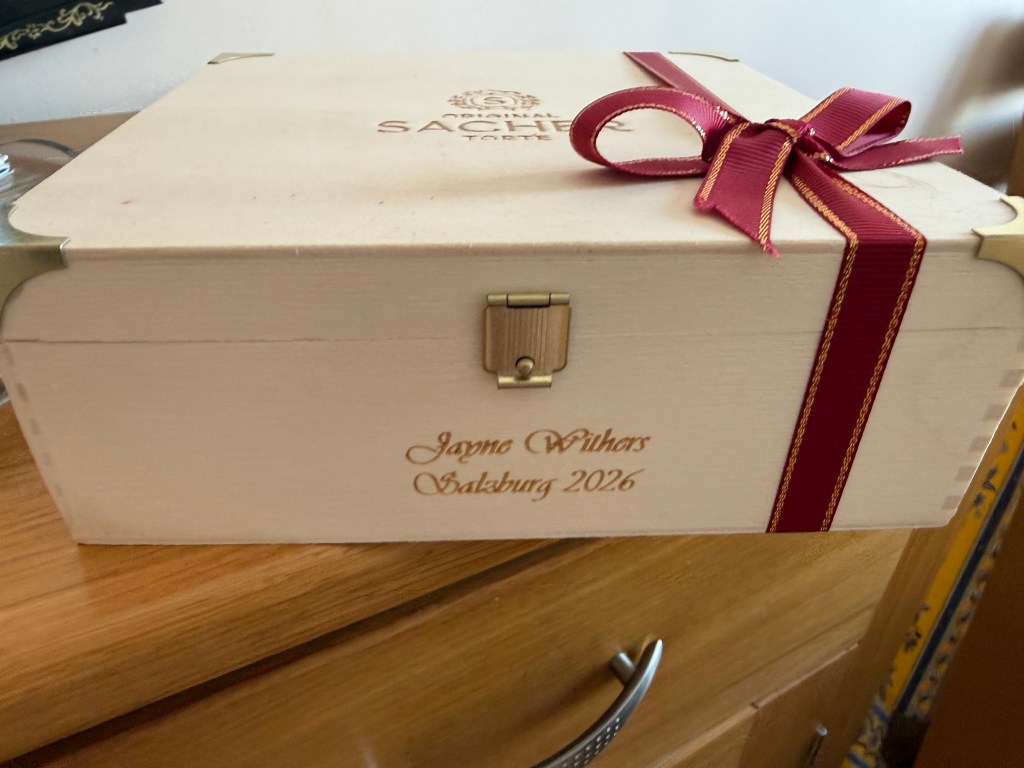
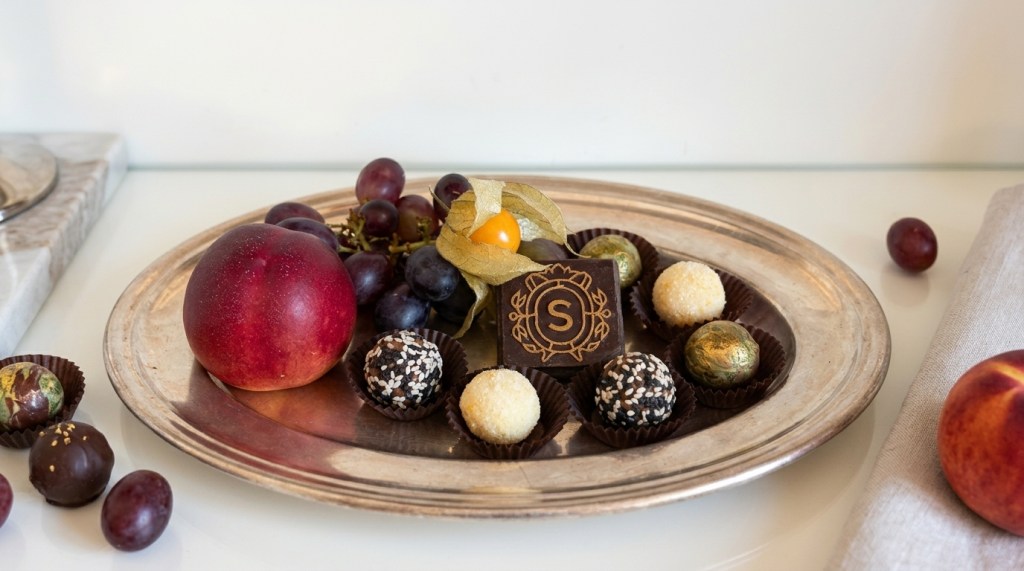
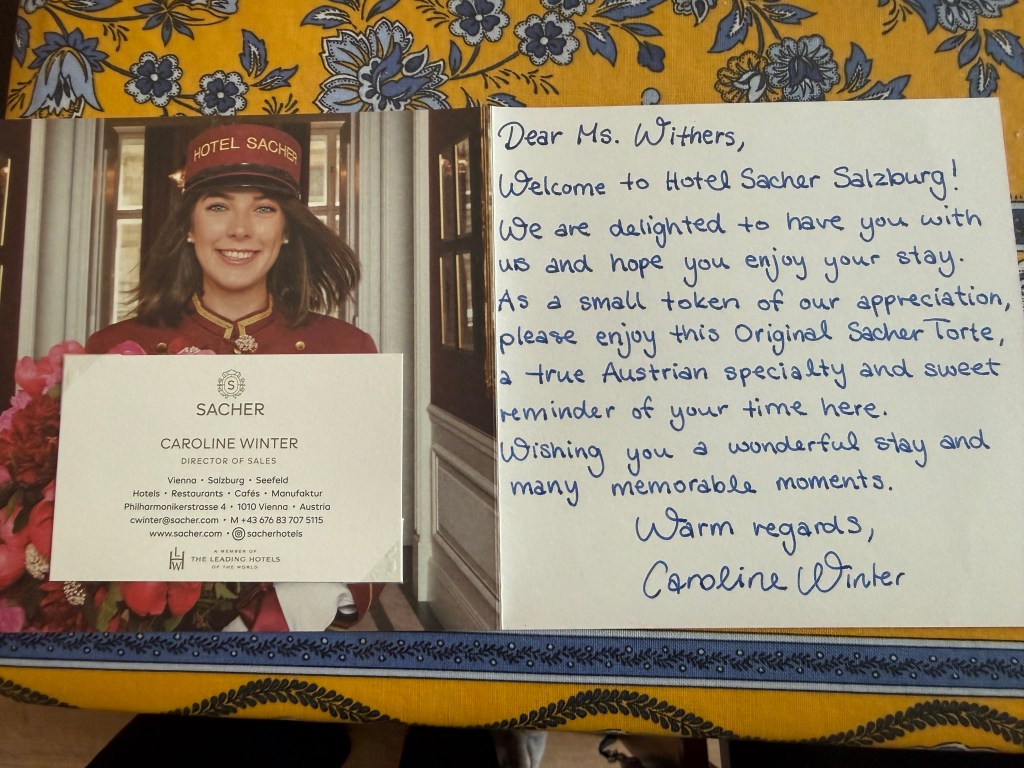
Having been presented with two miniature cakes and a plate of truffles as well, I took the big one to England to share with my dad. It took us a full five days to finish it.
My Sound of Music Mission
I wanted to see more of Salzburg, but I was being unrealistic. I had less than 48 hours in the city, and I needed to stay focused on my mission.
I work in luxury travel, but this was my trip. I’m accustomed to arranging private tours and securing exclusive access, yet somehow the idea of being the sole guest and singing along to The Lonely Goatherd with just a guide didn’t seem quite right.
So there I was, with 70 of my new best friends, aboard a Salzburg Panorama Tours coach brightly painted with characters from the film. Our guide seated us in rows, and I found myself next to a delightful music teacher from England. A fellow Brit.
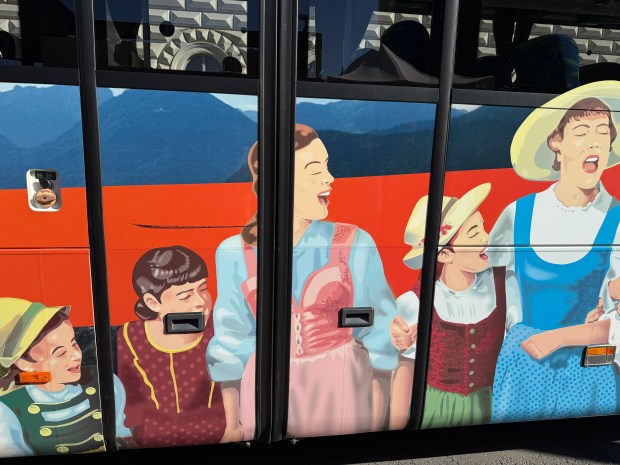
However — because I like to say there’s always a “however” — I can’t sing to save my life. I was chucked out of the school choir in seventh grade for singing flat. I’d already anticipated that I might have Marty Hammerstein’s granddad turning in his grave once again, but I was looking forward to belting out a few renditions of How Do You Solve a Problem Like Maria?
But a music teacher? Why me?
My belting became a muffled squeak, directed into my hand, which was pretty much clamped over my mouth.
Still, it was enormous fun. New temporary friendships were formed, and we shared our love of the film with the sort of camaraderie that only a common obsession can inspire. I was wearing a green floral dress, which our guide announced looked remarkably like the curtains Maria uses to make clothes for the Von Trapp children. I suppose I fitted right in, then.
We also learned a great deal about the real Von Trapp family: the Captain’s distinguished military background, his first wife, and his actual relationship with the children, which was apparently far less Draconian than the film’s early scenes suggest.
Schloss Leopoldskron: The Lake and the House
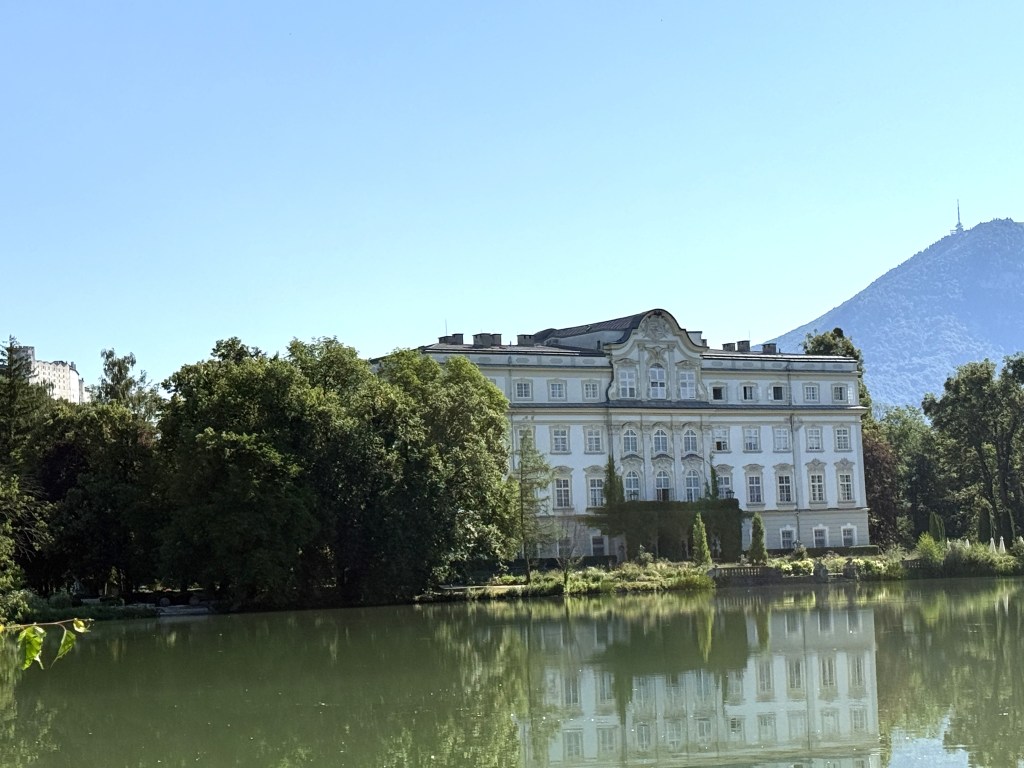
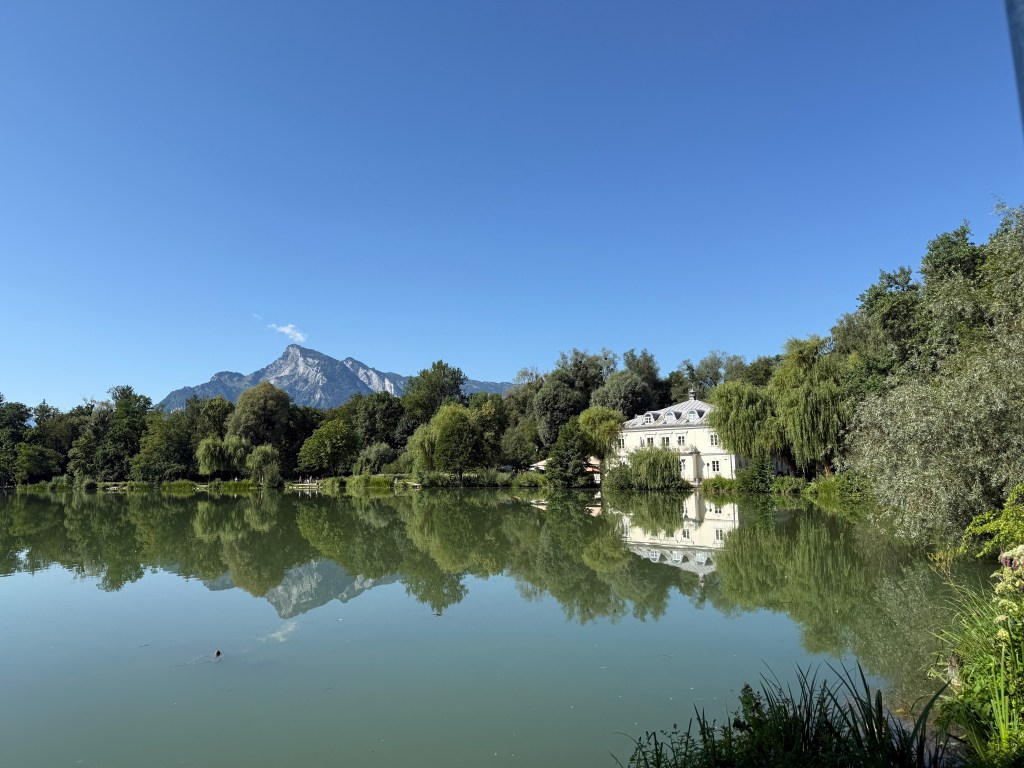
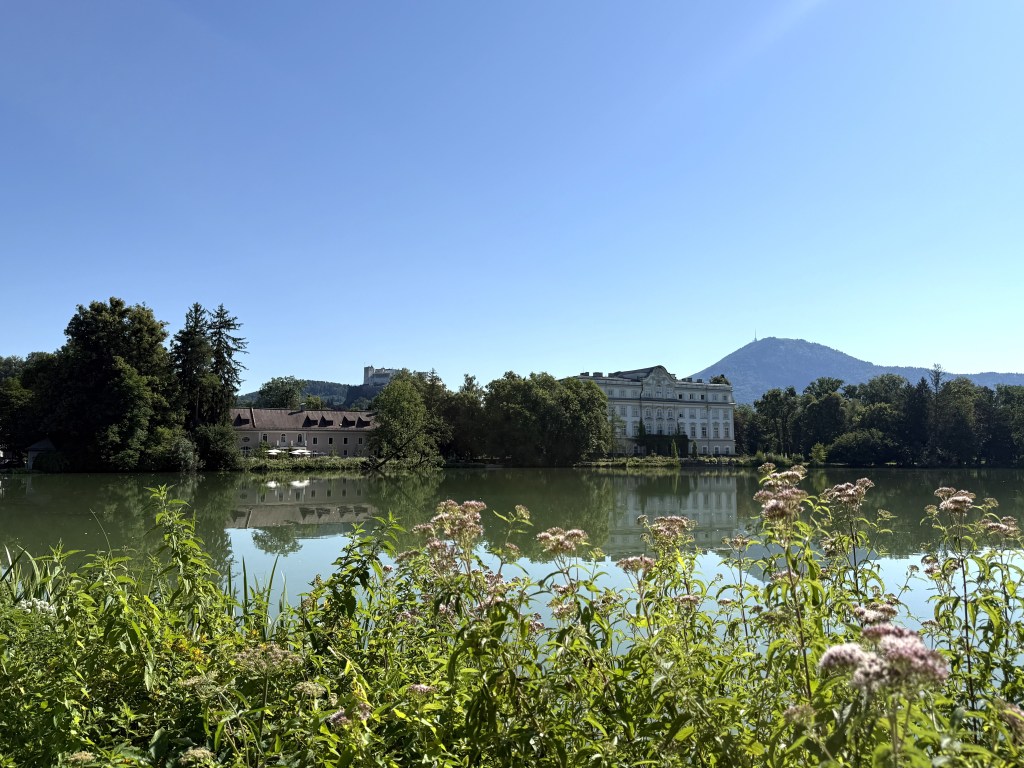
Our first stop was Schloss Leopoldskron, where the exterior lake scenes were filmed. This is where the magic of the film begins to feel tangible.
The palace sits beside its own lake, with the mountains providing a wonderfully dramatic backdrop. It is also a working hotel, occupying private property, so visitors on the tour view the house from across the water rather than wandering through its grounds. Access is restricted to preserve the experience for hotel guests.
I had known the scenes for decades, of course, but seeing the actual setting was something else. It was a reminder that the landscapes I had carried around in my imagination for so long were real places, not merely cinematic backdrops.
There was more to come.
The Pavilion at Hellbrunn Palace
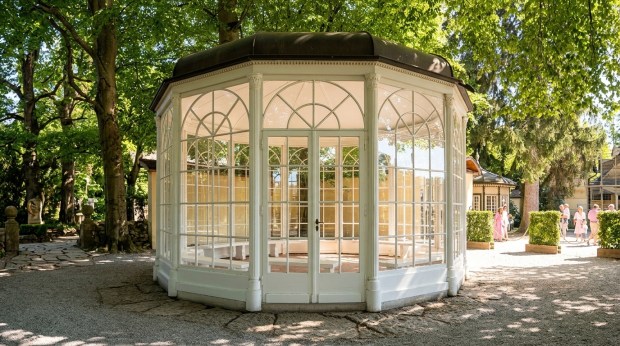
Next, we headed to Schloss Hellbrunn, where one of two replicas of the famous pavilion now stands. The original pavilion was associated with Schloss Leopoldskron, but the sheer influx of visitors wanting to see it eventually led to its relocation to Hellbrunn.
Sadly, you cannot go inside.
Perhaps that’s just as well. During filming, Charmian Carr, who played Liesl Von Trapp, slipped and injured her leg when it went through one of the glass panes. Regardless, had they allowed me inside, I would undoubtedly have been leaping from bench to bench, singing I Am Sixteen Going on Seventeen.
At sixty, going on seventy, perhaps not.
Hellbrunn Palace itself merits a visit quite apart from its Sound of Music connections. It is firmly on my list for next time.
On our way there, we had driven past Schloss Frohnburg, whose façade was used for the imposing courtyard and gates of the Von Trapp residence. You may remember it from Maria’s arrival at the family home, when she first meets the Captain and his children and sings I Have Confidence.
It is extraordinary how a building can become so familiar when you have never actually seen it.
Into the Salzkammergut
From there, we began our scenic drive into Salzburg’s stunning Salzkammergut Lake District.
We passed Lake Fuschl, catching a glimpse of the Rosewood property and immediately adding it to my list for another visit, followed by Lake Wolfgang.
And then, rather unexpectedly for a Sound of Music tour, we passed the original Red Bull headquarters.
It had taken me all these years to discover that Red Bull is Austrian. The company was founded in Fuschl am See by Dietrich Mateschitz, who encountered a popular Thai energy drink, Krating Daeng, during a visit to Thailand. He adapted the concept for European tastes, and Red Bull was born in 1987.
But let’s get back to Baroque.
Mondsee: A Wedding and a Wandering
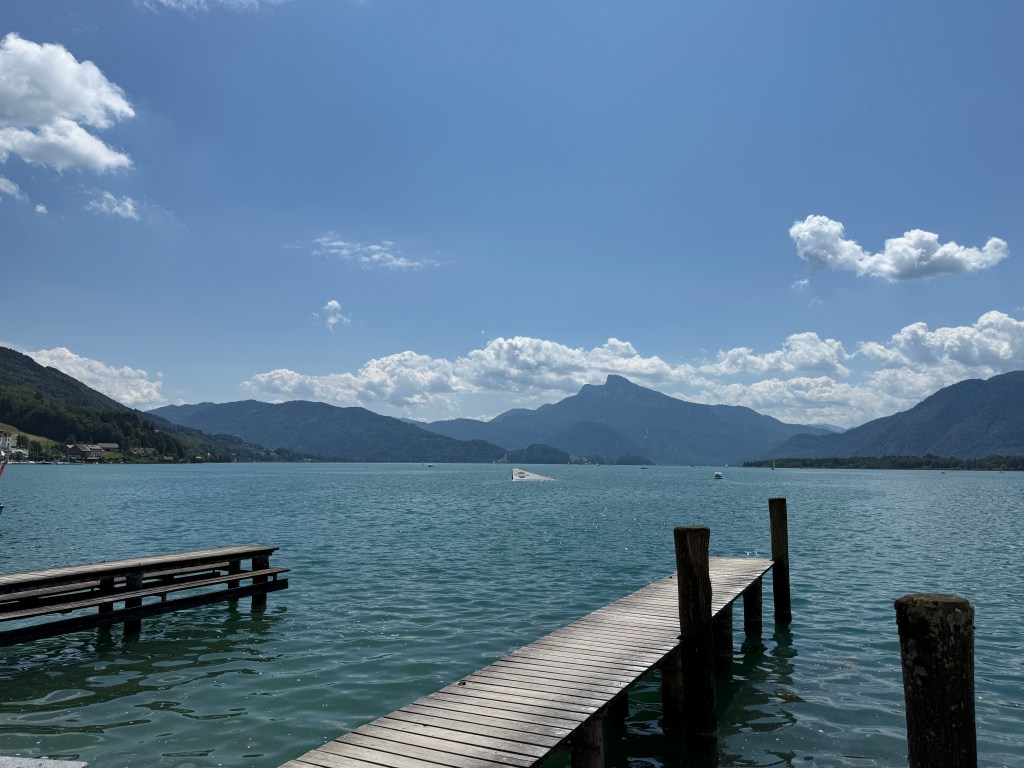
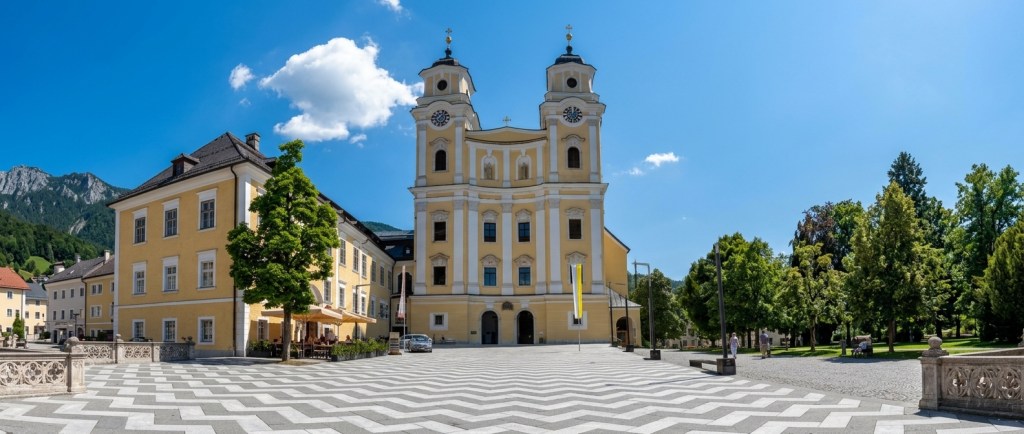
We were given plenty of time to explore the picturesque town of Mondsee, where the interior of St Michael’s Basilica provided the setting for Maria and Georg von Trapp’s wedding in the film.
In reality, the couple married at Salzburg’s Nonnberg Abbey.
I thoroughly enjoyed our stop in Mondsee. I browsed the shops, then wandered down towards the lake before we climbed back aboard the coach for the return journey to Salzburg.
Naturally, there was considerably more singing on the way back.
Mirabell Gardens: The Moment It All Came Together
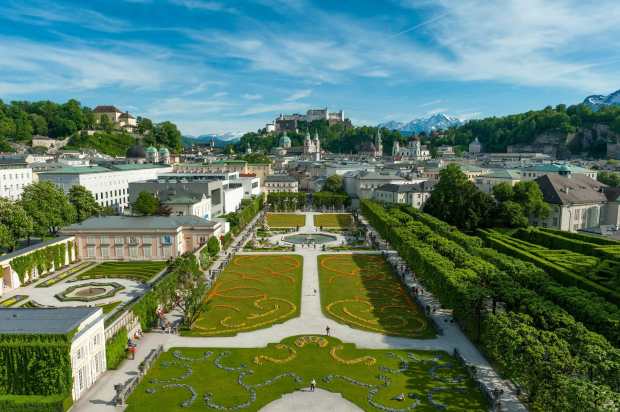
As the tour drew to a close, many of our fellow passengers left to pursue other tours and activities. That was a shame, because Mirabell Gardens turned out to be one of my favourite places in Salzburg.
Earlier that day, I had walked through the gardens on my way to the tour’s meeting point without making the connection. I had been standing in the very setting used for much of the famous Do-Re-Mi sequence.
Once I realised, I was quite overwhelmed. The scene is particularly clever in the way it weaves together different parts of the gardens, creating a seamless musical journey through Salzburg’s Baroque landscape.
It was extraordinarily difficult not to break into song and dance. I wanted so badly to skip through the gardens and leap around the fountain.
Instead, I walked into Altstadt, did a little window-shopping in my curtain dress and enjoyed a delightful lunch.
I was behaving myself. Just about.
Did I See Enough of Salzburg?
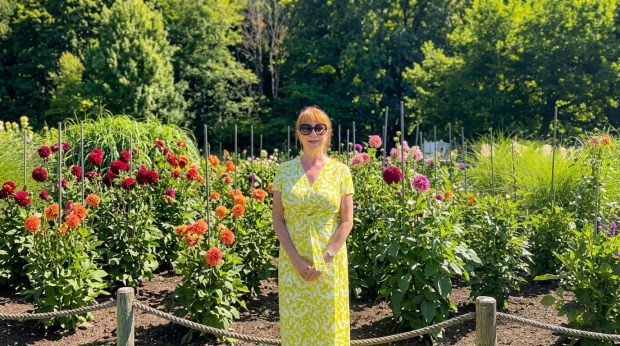
There is something deeply stirring about fulfilling a bucket-list dream. This was an emotional experience, to be sure. I still tear up when I think about it.
If my life is ever celebrated, I want Climb Every Mountain to be sung. Full voice. Belting it out, flat or perfectly in tune, I really don’t mind.
Did I see enough of Salzburg?
My heart did.
But I’d love to return. After all, I barely scratched the surface of Mozart’s world, and there is so much more of this beautiful city to discover.
Next time…

